Think your in the perfect relationship? Beweare
http://bigthink.com/ideas/41823
A man and woman have been married for over a decade. The wife seems happy, and she feels happy, or happy enough, in her marriage. The husband seems happy. He seems that way to outsiders and to his wife, and there hasn’t been conversation or behavior to make her suspect otherwise. Daily life is filled with household maintenance and chores, anyway—shuttling the children to events, and work. But that’s modern life, the wife thinks, and sees nothing wrong with it ....
Thuringer
Friday, January 6, 2012
Monday, August 29, 2011
Kanye West's Best Lines
Let me be clear, I think Kanye West is egotistical as fuck. The guy thinks he is the best, he thinks he is a god, but he also knows he thinks this.
That didn't make much sense, let me rephrase: He knows he is egotistical as fuck. He's fully aware of the negative image his has cultivated from his ego as well as he is fully ware that his ego is what can make him so great. Only a man with a giant ego, who is so far off the grid yet still somehow in the mainstream, could come up with some of the lyrics he does.
My prime example, and what inspired me to write this, was a line off of "Power" that glorifies drunk driving:
I wanted to go through a few more of Ye's best lines, and invite you to comment and tell me your favorite.
Speaking of his need for material objects, this is just a great verse from "All Falls Down":
This verse touches on so much, which is why I included the whole thing. First off, he's clearly aware of his need of material items. He then proceeds to comment on how having money and material items isn't actually the "American Dream." He finishes the verse by stating that no matter how much wealth he has, he is still black. Powerful stuff here.
Still, the most poingint thing Kanye ever sang was probably in his most popular song:
Just for fun, Kanye's biggest miss is:
Complete lyrics: http://www.directlyrics.com/kanye-west-all-of-the-lights-lyrics.html
That didn't make much sense, let me rephrase: He knows he is egotistical as fuck. He's fully aware of the negative image his has cultivated from his ego as well as he is fully ware that his ego is what can make him so great. Only a man with a giant ego, who is so far off the grid yet still somehow in the mainstream, could come up with some of the lyrics he does.
My prime example, and what inspired me to write this, was a line off of "Power" that glorifies drunk driving:
How's Ye doin'? I'm survivingI love this line because it makes drunk driving, which is a cultural abomination, seem so cool. My biggest fear in life is getting a DUI, yet I fucking love this line. This is also the reason I like Kanye West, only he could pull lines off like this. I think his ego has a lot do with it.
I was drinkin' earlier, now I'm driving
I wanted to go through a few more of Ye's best lines, and invite you to comment and tell me your favorite.
Restraining order, can’t see my daughterThis line(s) flow great, it's funny, and there is a reference to a now-defunct book store chain. I mostly love how there is a particular order to this unnamed woman's family's hate for Kanye.
Her mother, brother, grandmother hate me in that order
Public visitation, we met at Borders
Told her she take me back, I’ll be more supportive
Fresh air rolling down your windowI don't care if it makes no sense, a Family Matters reference will always win out.
Too many Urkles on your team that's why you Winslow
I had a dream I could buy my way to heaven, when I awoke I spent that on a necklaceKanye's always touching on his higher ambitions being overshadowed by his greed and need of material objects, never did he convey it better than this line.
Speaking of his need for material objects, this is just a great verse from "All Falls Down":
Man I promise, I'm so self conscious
That's why you always see me with at least one of my watches
Rollies and Pasha's done drove me crazy
I can't even pronounce nothing, pass that versace!
Then I spent 400 bucks on this
Just to be like nigga you ain't up on this!
And I can't even go to the grocery store
Without some ones thats clean and a shirt with a team
It seems we living the american dream
But the people highest up got the lowest self esteem
The prettiest people do the ugliest things
For the road to riches and diamond rings
We shine because they hate us, floss cause they degrade us
We trying to buy back our 40 acres
And for that paper, look how low we a'stoop
Even if you in a Benz, you still a nigga in a coop/coupe
This verse touches on so much, which is why I included the whole thing. First off, he's clearly aware of his need of material items. He then proceeds to comment on how having money and material items isn't actually the "American Dream." He finishes the verse by stating that no matter how much wealth he has, he is still black. Powerful stuff here.
My favorite girl wanna leave me just because I got a girlfriendFirst time I ever heard Kanye. This was before he was famous, before College Dropout. Perfect display about how crazy girls can be ... and how crazy Kanye can be. Of course his best line from that song was:
my freak girl told me "now, she a christian"
my white girl wanna move back to Michigan
I'm pullin girls off the bench like a sixth man
Don't know what's better – getting laid or getting paidA conundrum for the ages, no doubt
I just know when I'm getting one the other's getting away.
All my people’s that drug dealing just to get byAwesome wordplay, and it kind of makes me want to be a drug dealer.
stack your money till it get sky high
we wasn’t ‘posed make it passed 25
jokes on you we still alive
I’m like a fly Malcolm XYeah, that's just a really fucking cool line.
Buy any jeans necessary
Still, the most poingint thing Kanye ever sang was probably in his most popular song:
No one man should have all that powerHe was clearly talking about himself.
Just for fun, Kanye's biggest miss is:
I treat the cash the way the government treats AIDSUnnecessary "get it" at the end. Yes, it helps the flow of his song "Gorgeous" but I think it would have been much better to let the listener come to the conclusion instead of forcing it upon them.
I won't be satisfied til all my niggas get it, get it?
Complete lyrics: http://www.directlyrics.com/kanye-west-all-of-the-lights-lyrics.html
Thursday, June 23, 2011
Deep Thoughts on the Suns, Steve Nash and the NBA Draft
The NBA Draft is today and I have been putting quite a great deal of thought into it, mostly because I am unemployed and have the time to think about such things. Since I use this blog to think critically about various issues in life I am going to apply that to what I think the Phoenix Suns need to do today.
The Nash Issue
Suns aren't going to trade Steve Nash, I think that is pretty clear. There are a contingent of people who think the Suns should trade him, because they need to full-on rebuild instead of continuing to exist in competitive limbo.
How did the Suns get into competitive limbo (too good to get a high draft pick, not good enough to seriously contend)? Well it is simple really, they let Amare Stoudemire leave and replaced him with:
For the record, I don't consider Channing Frye's contract to be bad. He's not great, but he's worth $6 million/year in the current NBA (this could all change after the lockout).
The problem with trading Nash is, he is not as valuable as many Suns fans think he is. It has nothing to do with talent, it has to do with the following:
The Suns can compete next year
Entering the 2011-12 season (if there is one), I think the Suns can actually compete. You may think I'm crazy, but I think it is possible. The Suns had a terrible start to the season last year, and were involved in a major trade before they could figure each other out. This re-started the "feeling out" process, and by the time the Suns figured each other out they had no room for error. When they did gel, the Suns improved from 21-24 to 33-29 and looked to be playoff contenders. All this while the corpse of Vince Carter was (inexplicably) starting at SG. The Suns were then dealt injuries to Frye and Nash and were effectively done without any leeway due to their poor start.
If the Suns add a SG with a pulse and another big man (or if Robin Lopez is able to return to his 2009-10 form, but don't hold your breath), the Suns could compete for a playoff spot next year. Is it sexy? No, but at least it isn't wasting Nash's final years in Phoenix. As the Dallas Mavericks just showed us, you never really know what can happen in the NBA.
Of course the counter to this is that the Suns owner is Robert Sarver, and he kills any hope of winning. I can't argue that point, personally I believe Sarver is the worst owner in the history of the state.
Sidenote: I know Bill Bidwill is the logical choice for worst owner in the history of the state, but Bidwill never took over a championship caliber team and fucked it into oblivion quite like Sarver did.
Draft Strategy
With my thoughts on Nash and the ability for the team to compete out of the way, let's move on to tonight's draft. The Suns need to target a SG or PF, although they seem to be interested in a PG as well. Here are eight players the Suns might be looking at.
Klay Thompson SG Washington State 6-7, 206
If the Suns want to compete right away, Thompson should probably be their pick. He is a great shooter, who can shoot for mid-range or behind the arc and would probably play very similar to Jason Richardson (without the dunking) next to Nash. The issue with Klay is that he doesn't help the team defensively. Picking Klay is more of a move towards Suns teams of the past and I don't think the front office is too interested in that. Teams also seem to be concerned that he got caught smoking weed while at Wazzu. Is that really an issue? Shit, Barney Frank and Ron Paul and are efforting to decriminalize that in congress right now.
Alec Burks SG Colorado 6-6, 193
Burks is an athletic slasher with good upside and the ability to play some PG in the pros. I doubt he will be around when the Suns pick, but I think he would be the perfect player to help the team out now while still possessing enough upside to make this a pick for the future. He could do what Vince Carter did last year right away, except he would have a pulse. He is probably going to go around the 10th pick, and has some serious Paul Pierce/Danny Granger potential (in terms of when we look back on the draft in five years we will say "how did Burks slide so far?")
Tristian Thompson PF Texas 6-9, 228
The Suns like Thompson because he has potential on both sides of the ball. He is a little small to play PF, but this is the same team that gave a huge contract to Hakim Warrick, who plays PF and is actually smaller than Thompson. I think Thompson can do what Warrick did last year right away, and the Suns love his defensive potential.
Bismack Biyombo C Congo 6-9, 240
Biyombo has the best name in the draft. He also has an amazing wingspan (7-6!). On offense, he, well, did I tell you about his wingspan? His ceiling is Ben Wallace, but it is going to take him years to get to where still-developing Serge Ibaka is right now. Biyombo is a hot prospect because he played in a high-level pro league in Spain last year and averaged five rebounds and two blocks in about 17 minutes per game. He wouldn't be a bad selection for the Suns. Think of him as Lou Amundson in year one, with the potential to become Serge Ibaka.
Markieff Morriss PF Kansas 6-9, 240
I'm not sure what Morris (him or Marcus) is the good brother, but if the Suns are targeting Markieff then he is probably the lesser of the two brothers. Probably would help the Suns right away, but not a sexy pick and doesn't possess huge amounts of upside. Would be a decent selection to help the Suns compete next year. Does a lot of things well, does nothing great.
Jordan Hamilton SG/SF Texas 6-8, 223
Can shoot, can't play defense, has a game similar to Joe Johnson. Although he probably would be more like 2001-2003 Joe Johnson, and not anything like 2004-present Joe Johnson. Considering that NBADraft.net compares him to Cedric "Nuff Ced" Ceballos, I thought I would include him.
Jimmer (you know the details)
I don't need to break down Jimmer for you. Would be a huge boost to his career to play with Nash. Might not be a huge boost to the Suns 2011-12 win total, however.
Chris Singleton SF Florida State 6-9, 220
Long, athletic, a good defender whose only projected offensive skill at the moment is three-point shooting. Really wants to be Scottie Pippen, sounds more like his ceiling is Bruce Bowen. I'd like to see him on the Suns, however.
Iman Shumpert PG Gerogia Tech 6-6, 220
Suns fans are going to have a shit-fit if this selection happens, and it sounds like it is going to. Shumpert is one of the most physically-impressive people in the draft. He has amazing size for a point-guard. The only problem is it sounds like he has no idea how to play offense, how to run an offense or what shots to take. I am picturing an athletic Brian Shaw.
Kenneth Faired PF Morehead State 6-7, 225
Faried can rebound. That might be all he can do. His NBADraft.net comparison is Lou Amundson. He would help the Suns instantly on the boards and would probably play some tough defense, but he will never really evolve into more than that. Unless he becomes the next Dennis Rodman. I'd actually like the see him in Phoenix.
Special surprise sleeper: Kemba Walker! The fan base would love it.
My official prediction: Iman Shumpert's name gets called and causes a Calvin Pace-type reaction.
Who I want: If Alec Burk were to slide, it would be a steal. If not, one of the Thompsons (Klay or Tristian).
The Nash Issue
Suns aren't going to trade Steve Nash, I think that is pretty clear. There are a contingent of people who think the Suns should trade him, because they need to full-on rebuild instead of continuing to exist in competitive limbo.
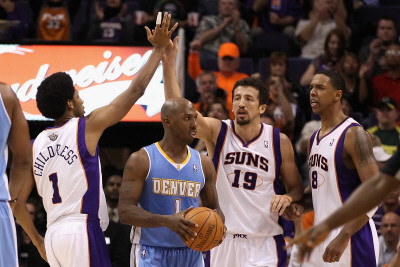
How did the Suns get into competitive limbo (too good to get a high draft pick, not good enough to seriously contend)? Well it is simple really, they let Amare Stoudemire leave and replaced him with:
| High-five for our awesome, cap-killing contracts |
The problem with trading Nash is, he is not as valuable as many Suns fans think he is. It has nothing to do with talent, it has to do with the following:
- The organization would never trade Nash to a non-contender. As nice as the rumored Minnesota trade in which the Suns would get the #2 pick is, it isn't going to happen. This limits the teams that he could be sent to, and better teams usually don't have as many young assets to send back in return for a player like Nash.
- Without Nash, the Suns are terrible and no one goes to the games. Nash drives attendance and viewership for the Suns. He means everything to the fans of the team. There isn't a contending team that can return enough quality assets to make up for losing Nash's skill and his value to the city. Value to a city, it's not something that can be measured by a stat. When I hear someone say we should trade Nash, I know they are also the person who is going to rarely watch a Suns game while they are rebuilding.
- Teams don't value Nash like Phoenix would. This is because Nash doesn't have a value to the prospective city he might be traded to. So while player A and draft pick B may look decent on paper, it would still be a disaster for Phoenix because of the huge value gap that player A and Nash would have to the city. Yet the team trying to trade Nash wouldn't, and shouldn't, include Nash's value to the Phoenix community into the talent equation of their trade.
The Suns can compete next year
Entering the 2011-12 season (if there is one), I think the Suns can actually compete. You may think I'm crazy, but I think it is possible. The Suns had a terrible start to the season last year, and were involved in a major trade before they could figure each other out. This re-started the "feeling out" process, and by the time the Suns figured each other out they had no room for error. When they did gel, the Suns improved from 21-24 to 33-29 and looked to be playoff contenders. All this while the corpse of Vince Carter was (inexplicably) starting at SG. The Suns were then dealt injuries to Frye and Nash and were effectively done without any leeway due to their poor start.
If the Suns add a SG with a pulse and another big man (or if Robin Lopez is able to return to his 2009-10 form, but don't hold your breath), the Suns could compete for a playoff spot next year. Is it sexy? No, but at least it isn't wasting Nash's final years in Phoenix. As the Dallas Mavericks just showed us, you never really know what can happen in the NBA.
Of course the counter to this is that the Suns owner is Robert Sarver, and he kills any hope of winning. I can't argue that point, personally I believe Sarver is the worst owner in the history of the state.
Sidenote: I know Bill Bidwill is the logical choice for worst owner in the history of the state, but Bidwill never took over a championship caliber team and fucked it into oblivion quite like Sarver did.
Draft Strategy
With my thoughts on Nash and the ability for the team to compete out of the way, let's move on to tonight's draft. The Suns need to target a SG or PF, although they seem to be interested in a PG as well. Here are eight players the Suns might be looking at.
Klay Thompson SG Washington State 6-7, 206
If the Suns want to compete right away, Thompson should probably be their pick. He is a great shooter, who can shoot for mid-range or behind the arc and would probably play very similar to Jason Richardson (without the dunking) next to Nash. The issue with Klay is that he doesn't help the team defensively. Picking Klay is more of a move towards Suns teams of the past and I don't think the front office is too interested in that. Teams also seem to be concerned that he got caught smoking weed while at Wazzu. Is that really an issue? Shit, Barney Frank and Ron Paul and are efforting to decriminalize that in congress right now.
Alec Burks SG Colorado 6-6, 193
Burks is an athletic slasher with good upside and the ability to play some PG in the pros. I doubt he will be around when the Suns pick, but I think he would be the perfect player to help the team out now while still possessing enough upside to make this a pick for the future. He could do what Vince Carter did last year right away, except he would have a pulse. He is probably going to go around the 10th pick, and has some serious Paul Pierce/Danny Granger potential (in terms of when we look back on the draft in five years we will say "how did Burks slide so far?")
Tristian Thompson PF Texas 6-9, 228
The Suns like Thompson because he has potential on both sides of the ball. He is a little small to play PF, but this is the same team that gave a huge contract to Hakim Warrick, who plays PF and is actually smaller than Thompson. I think Thompson can do what Warrick did last year right away, and the Suns love his defensive potential.
Bismack Biyombo C Congo 6-9, 240
Biyombo has the best name in the draft. He also has an amazing wingspan (7-6!). On offense, he, well, did I tell you about his wingspan? His ceiling is Ben Wallace, but it is going to take him years to get to where still-developing Serge Ibaka is right now. Biyombo is a hot prospect because he played in a high-level pro league in Spain last year and averaged five rebounds and two blocks in about 17 minutes per game. He wouldn't be a bad selection for the Suns. Think of him as Lou Amundson in year one, with the potential to become Serge Ibaka.
Markieff Morriss PF Kansas 6-9, 240
I'm not sure what Morris (him or Marcus) is the good brother, but if the Suns are targeting Markieff then he is probably the lesser of the two brothers. Probably would help the Suns right away, but not a sexy pick and doesn't possess huge amounts of upside. Would be a decent selection to help the Suns compete next year. Does a lot of things well, does nothing great.
Jordan Hamilton SG/SF Texas 6-8, 223
Can shoot, can't play defense, has a game similar to Joe Johnson. Although he probably would be more like 2001-2003 Joe Johnson, and not anything like 2004-present Joe Johnson. Considering that NBADraft.net compares him to Cedric "Nuff Ced" Ceballos, I thought I would include him.
Jimmer (you know the details)
I don't need to break down Jimmer for you. Would be a huge boost to his career to play with Nash. Might not be a huge boost to the Suns 2011-12 win total, however.
Chris Singleton SF Florida State 6-9, 220
Long, athletic, a good defender whose only projected offensive skill at the moment is three-point shooting. Really wants to be Scottie Pippen, sounds more like his ceiling is Bruce Bowen. I'd like to see him on the Suns, however.
Iman Shumpert PG Gerogia Tech 6-6, 220
Suns fans are going to have a shit-fit if this selection happens, and it sounds like it is going to. Shumpert is one of the most physically-impressive people in the draft. He has amazing size for a point-guard. The only problem is it sounds like he has no idea how to play offense, how to run an offense or what shots to take. I am picturing an athletic Brian Shaw.
Kenneth Faired PF Morehead State 6-7, 225
Faried can rebound. That might be all he can do. His NBADraft.net comparison is Lou Amundson. He would help the Suns instantly on the boards and would probably play some tough defense, but he will never really evolve into more than that. Unless he becomes the next Dennis Rodman. I'd actually like the see him in Phoenix.
Special surprise sleeper: Kemba Walker! The fan base would love it.
My official prediction: Iman Shumpert's name gets called and causes a Calvin Pace-type reaction.
Who I want: If Alec Burk were to slide, it would be a steal. If not, one of the Thompsons (Klay or Tristian).
Sunday, April 17, 2011
Ratings > Playoffs
Both the NBA and NHL playoffs are starting this week and sports media professionals and amateurs alike are set to make predictions. I figured I might as well too, but first I want to tackle the most important issue that faces every sport come playoff time except football: ratings.
Every playoff features a doomsday scenario, a match up of two teams that won’t hold the general interest of the nation. Die hards of a sport will always care, but the casual fans tunes in for big markets. The problem is the worst in baseball. Here are a list of baseball teams ESPN likes to air during the regular season:
New York Yankees
Boston Red Sox
New York Yankees' opponent
Boston Red Sox's opponent
I admit, I am exaggerating a bit . . . just a bit. TBS is the worst at this actually, ever since they secured the rights to air games on Sunday mornings I swear they’ve shown the Red Sox or Yankees 95% of the time.
This is clearly done for ratings. The NBA is not as bad (they have limits on how many times a team can be nationally televised) and it will find a way to get talented players on the airwaves regardless of market (much like Oklahoma City). Since the NBA is a 5 on 5 sport, it is easier to highlight a great individual than it is in baseball or hockey. But still, these three sports usually rely on certain teams to pull ratings.
The problem: If these teams aren’t advancing far in the playoffs, the league hemorrhages viewers. Take the World Series last year, a very interesting match up featuring new blood in the Texas Rangers and San Francisco Giants. Neither team was anyone’s pre-season pick to reach the World Series, both teams featured marketable stars (Josh Hamilton for the Rangers, Tim Lineccum for the Giants), yet the talk leading up to the World Series was that it might be a ratings disaster. The MLB, a sport dominated by their big East Coast markets, had a worst-case scenario World Series (strictly from a ratings standpoint). The NBA has a similar problem when the Lakers are not in the finals, so much so that many freely subscribe to conspiracy theories that the league is manipulating the games to get them to advance.
Clearly, the leagues rely on these marquee teams a lot. If these leagues keep showing the same, popular teams, this cycle can never be broke. We’ve been inundated with so many Yankees and Red Sox games and talk this past decade that I honestly have no idea how the MLB would survive if they ever had down years. That’s why a salary cap can’t be implemented in baseball. If the Yanks or Sox were forced to restrict spending, the MLB couldn't guarantee they will be good every year and the league has nowhere else to turn.
The best way to brake this model is to show good and interesting teams, regardless of market. A league might lose viewers, but the hope is that these interesting teams would gain enough attention to increase the MLB, NHL and NBA’s stable of marketable teams. The NBA currently does the best job at this, in my opinion, and the MLB the worst.
If I submitted this argument to Colin Cowheard, he would probably say “But youuuuuuuuuuuuuu want to see the Yanks/Sox, yoooouuuuuuuuuuuuu don’t watch if they aren’t on, we are just doing what youuuuuuuuuuuuuuu want”
That’s the same argument that gives us this:
And takes away this:
Every playoff features a doomsday scenario, a match up of two teams that won’t hold the general interest of the nation. Die hards of a sport will always care, but the casual fans tunes in for big markets. The problem is the worst in baseball. Here are a list of baseball teams ESPN likes to air during the regular season:
New York Yankees
Boston Red Sox
New York Yankees' opponent
Boston Red Sox's opponent
I admit, I am exaggerating a bit . . . just a bit. TBS is the worst at this actually, ever since they secured the rights to air games on Sunday mornings I swear they’ve shown the Red Sox or Yankees 95% of the time.
This is clearly done for ratings. The NBA is not as bad (they have limits on how many times a team can be nationally televised) and it will find a way to get talented players on the airwaves regardless of market (much like Oklahoma City). Since the NBA is a 5 on 5 sport, it is easier to highlight a great individual than it is in baseball or hockey. But still, these three sports usually rely on certain teams to pull ratings.
The problem: If these teams aren’t advancing far in the playoffs, the league hemorrhages viewers. Take the World Series last year, a very interesting match up featuring new blood in the Texas Rangers and San Francisco Giants. Neither team was anyone’s pre-season pick to reach the World Series, both teams featured marketable stars (Josh Hamilton for the Rangers, Tim Lineccum for the Giants), yet the talk leading up to the World Series was that it might be a ratings disaster. The MLB, a sport dominated by their big East Coast markets, had a worst-case scenario World Series (strictly from a ratings standpoint). The NBA has a similar problem when the Lakers are not in the finals, so much so that many freely subscribe to conspiracy theories that the league is manipulating the games to get them to advance.
Clearly, the leagues rely on these marquee teams a lot. If these leagues keep showing the same, popular teams, this cycle can never be broke. We’ve been inundated with so many Yankees and Red Sox games and talk this past decade that I honestly have no idea how the MLB would survive if they ever had down years. That’s why a salary cap can’t be implemented in baseball. If the Yanks or Sox were forced to restrict spending, the MLB couldn't guarantee they will be good every year and the league has nowhere else to turn.
The best way to brake this model is to show good and interesting teams, regardless of market. A league might lose viewers, but the hope is that these interesting teams would gain enough attention to increase the MLB, NHL and NBA’s stable of marketable teams. The NBA currently does the best job at this, in my opinion, and the MLB the worst.
If I submitted this argument to Colin Cowheard, he would probably say “But youuuuuuuuuuuuuu want to see the Yanks/Sox, yoooouuuuuuuuuuuuu don’t watch if they aren’t on, we are just doing what youuuuuuuuuuuuuuu want”
That’s the same argument that gives us this:
| I'm Gary Sinise and my career is in purgatory (aka CSI: [insert city]) |
And takes away this:
Tuesday, April 5, 2011
Critical Thinking is Always the Answer
There is a dearth of critical thinking in today's society. Before I explain my reasoning, I want to define the term. According to CriticalThinking.org:
To prove my theory I offer two examples. One serious, one not so serious.
Charlie Sheen
Charlie Sheen conquered the Internet a month ago. Sheen's brand was red hot - in a, literally, crazy way. Sheen's legendary party habits gained the full attention of the public as, after losing his job, he did several interviews with media outlets that were instant hits on the Internet. He started a Twitter account and obliterated the record for "fastest profile to two million followers" one of those rare records that wouldn't have made any sense as little as four years ago. Sheen decided to capitalize on his evolving stardom by starting a tour he titled "The Violent Torpedo of Truth Tour." Many thought it was a great idea, those who can think critically knew it would be a disaster.
First, I must say that I do enjoy Sheen. I've always enjoyed his comedic acting and was entertained by his pure insanity a month ago. The problem was it had no lasting value. When his first tour stop, in Detroit, epically bombed, it was hardly a surprise. His evolving stardom was based on the shock value of his rants to media outlets. This shock value was always going to deteriorate, by its vary nature shock value has no lasting value. Shock always wears off. When Sheen's did, all that was left were his goofy terms that he reintroduced into the national lexicon (Warlock, Winning, Tiger's Blood, etc.) Can a few goofy terms really entertain an audience for almost two hours? The answer was no.
Beyond rants with rapidly deteriorating value and a few choice terms, Sheen can't do much else on the stage. He isn't a stand up comedian, he is an actor. Confusing the two is dangerous, see Michael Richards:
I didn't feel bad when people walked out of his first show demanding a refund. Learn to think critically! It seems to me that those who paid good money to see Sheen clearly only saw the face value of what Sheen was doing, and were unable to realize it had no longevity.
For the record, Sheen's show seems to have improved.
Politics
The lack of critical thinking in our country is evident at its highest level - politics. I'm not talking about the politicians themselves, however. I'm talking about the people who put them into office, the people who elect them to represent.
Politics is a game, a game that continues to play because we continue to willingly be the pieces. Politicians stick to talking points because they are successful. Too many people only want a summary of what is going on, they aren't patient enough to peruse all the information (I'm as guilty of this as anyone). Hence, we only care about talking points. We hear "death panels" and "obamacare" but the vast majority of us don't actually have any idea what they mean, we are just listening to the opinion of people whose political beliefs are aligned with ours. That's okay, but it also makes it counterproductive to complain about these people. Tired of negative campaigning? It is widely used because it is extremely effective - that's also our fault.
The thing about politics is that it is fairly easy to tell what is going on, it just takes some effort and some critical thinking. Anyone who looked beyond the surface during the 2010 mid-term elections could tell that a lot of politicians were campaigning on balancing the budget without presenting any real ideas on how to do it. However, as a nation we still fall in love with the politician preaching the grand message - even if he or she has no real plan to achieve it. We strive for fluff over substance. Further more, we are moving away from critical thinking. Well-educated candidates get labeled "elitist," turning their most positive qualities into negative ones. My idea of someone running the country isn't this guy:
It's this guy:
The argument against these educated people is that they are disconnected from regular people. Governing millions of people is a very complex problem, it is always going to take a certain level of disconnect to do the job. Disconnect also leads to clearer thinking, when one removes themselves from a situation they are more able to make accurate judgements on what is happening.
fandom and analyze actual reasons the Suns lost - most knowledgeable fans can. The question becomes, would you want someone running the Suns who thinks bad officiating is the reason the Suns always lose close games or would you want someone who realizes that poor defensive rotation (just an example) is the culprit? I guarantee you that the latter, the critical thinker, has better ideas how to improve the Suns.
The same argument is in effect or politics, the only problem is that everyone has a say in electing the people to run the country. If we want to improve this country we need to engage in more critical thinking and not shy away from candidates who do because they "don't get us."
Critical thinking is the intellectually disciplined process of actively and skillfully conceptualizing, applying, analyzing, synthesizing, and/or evaluating information gathered from, or generated by, observation, experience, reflection, reasoning, or communication, as a guide to belief and action. In its exemplary form, it is based on universal intellectual values that transcend subject matter divisions: clarity, accuracy, precision, consistency, relevance, sound evidence, good reasons, depth, breadth, and fairness.Basically, critical thinking is a deeper way of thinking about the world. It is often learned in higher education. It is a skill I am thankful to have learned while obtaining a masters degree. There are multiple levels to everything. All too often people never think about anything beyond the surface. They don't dig for additional information, they don't think about motivations; acceptance of face value is a national pastime in our country.
To prove my theory I offer two examples. One serious, one not so serious.
Charlie Sheen
Charlie Sheen conquered the Internet a month ago. Sheen's brand was red hot - in a, literally, crazy way. Sheen's legendary party habits gained the full attention of the public as, after losing his job, he did several interviews with media outlets that were instant hits on the Internet. He started a Twitter account and obliterated the record for "fastest profile to two million followers" one of those rare records that wouldn't have made any sense as little as four years ago. Sheen decided to capitalize on his evolving stardom by starting a tour he titled "The Violent Torpedo of Truth Tour." Many thought it was a great idea, those who can think critically knew it would be a disaster.
First, I must say that I do enjoy Sheen. I've always enjoyed his comedic acting and was entertained by his pure insanity a month ago. The problem was it had no lasting value. When his first tour stop, in Detroit, epically bombed, it was hardly a surprise. His evolving stardom was based on the shock value of his rants to media outlets. This shock value was always going to deteriorate, by its vary nature shock value has no lasting value. Shock always wears off. When Sheen's did, all that was left were his goofy terms that he reintroduced into the national lexicon (Warlock, Winning, Tiger's Blood, etc.) Can a few goofy terms really entertain an audience for almost two hours? The answer was no.
Beyond rants with rapidly deteriorating value and a few choice terms, Sheen can't do much else on the stage. He isn't a stand up comedian, he is an actor. Confusing the two is dangerous, see Michael Richards:
I didn't feel bad when people walked out of his first show demanding a refund. Learn to think critically! It seems to me that those who paid good money to see Sheen clearly only saw the face value of what Sheen was doing, and were unable to realize it had no longevity.
For the record, Sheen's show seems to have improved.
Politics
The lack of critical thinking in our country is evident at its highest level - politics. I'm not talking about the politicians themselves, however. I'm talking about the people who put them into office, the people who elect them to represent.
Politics is a game, a game that continues to play because we continue to willingly be the pieces. Politicians stick to talking points because they are successful. Too many people only want a summary of what is going on, they aren't patient enough to peruse all the information (I'm as guilty of this as anyone). Hence, we only care about talking points. We hear "death panels" and "obamacare" but the vast majority of us don't actually have any idea what they mean, we are just listening to the opinion of people whose political beliefs are aligned with ours. That's okay, but it also makes it counterproductive to complain about these people. Tired of negative campaigning? It is widely used because it is extremely effective - that's also our fault.
| Fuck you, John Adams |
The thing about politics is that it is fairly easy to tell what is going on, it just takes some effort and some critical thinking. Anyone who looked beyond the surface during the 2010 mid-term elections could tell that a lot of politicians were campaigning on balancing the budget without presenting any real ideas on how to do it. However, as a nation we still fall in love with the politician preaching the grand message - even if he or she has no real plan to achieve it. We strive for fluff over substance. Further more, we are moving away from critical thinking. Well-educated candidates get labeled "elitist," turning their most positive qualities into negative ones. My idea of someone running the country isn't this guy:
| No offense, dude |
| "Hmm, yes, epistemology and the such" |
fandom and analyze actual reasons the Suns lost - most knowledgeable fans can. The question becomes, would you want someone running the Suns who thinks bad officiating is the reason the Suns always lose close games or would you want someone who realizes that poor defensive rotation (just an example) is the culprit? I guarantee you that the latter, the critical thinker, has better ideas how to improve the Suns.
The same argument is in effect or politics, the only problem is that everyone has a say in electing the people to run the country. If we want to improve this country we need to engage in more critical thinking and not shy away from candidates who do because they "don't get us."
| And for the love of God stop listening to this man! |
Sunday, March 27, 2011
Playing the Game the Right Way
I was driving around today and listening to Freddie Coleman on ESPN Radio talking about how he despises the phrase "they play the game the right way" in basketball. I completely agree with Coleman and I started to do some deep thinking. As with all my posts (I know, this is only the second one) I use one topic to explore a variety of topics within it. Today, I want to talk a little bit about the covert racism that comes from playing the game the right way as well as the differences between college and pro basketball's style of play.
Back In My Day (and Other Things Old White Guys Say)
"They play the game the right way." (PGRW, I'm going to shorten it to an acronym for the purposes of this post) Think about that phrase. Think about who people are referring to when they say it. PGRW is praise often levied on white players that lack sufficient athletic ability and must master the fundamentals to compete. Coleman was talking about how Butler has been tagged with the PGRW label. Butler happens to be a mid-western school that is known for its white players (Matt Howard is probably their best player this year, Gordan Hayward was last year). PGRW has also described a program like Duke and a player like Jimmer Ferdette this March. Notice something? Duke is known for having successful white players and Ferdette is the most high profile white player in college basketball this year.
PGRW, I assume, means fundamentals. Google image search "fundamentals of basketball" and about one image of a black player is returned for every three of a white. You're damn right I am going to classify this as "research."
I've had people tell me that basketball needs to do away with dunking, because it is ruining the game. They are white by the way, and want to remove one of the biggest advantages black players have over white players (hmmmm). Players throwing down rim-rocking jams may be exciting, but it is detracting from a game that used to be about precision passing, backdoor cuts and set-jump shots.
Race is always a complicated subject matter and I am definitely not trying to make any accusations. People that use PGRW are not necessarily racist, they have, often unintentionally, bought into its narrative. The same goes for the term "scrappy." Has there ever been a scrappy black basketball player? Yet anytime a white guy fights for the rebound he is called scrappy, its a term of endearment. PGRW is more of an issue in college basketball than the pros, because college basketball contains so many more white players than the pros.
What exactly is playing the game the right way? Is the right way relying on pure fundamentals, passing, cuts, picks, defense and scraping out every possession against a superior athletic team? Is being able to use your natural athleticism to make a play that most can't the right way? Take this amazing play by Dwyane Wade:
Is that not how basketball should be played? I'll continue this conversation by stepping away from race to discuss . . .
Pro Basketball vs College Basketball
People love to debate what is better, pro or college ball. People who like college ball better usually talk about how the pro players don't try and the regular season is meaningless. People who like pro ball better usually just point to the inferior quality of play found in college ball. Personally, I think the NBA is far better, but I also think the two products should only be compared when attempting to evaluate the pro potential of the top college players.
College basketball is a completely different animal. The sport is all about coaching, or more aptly put, its all about over-coaching. Take the difference between a coach like Kentucky's John Calipari and Wisconsin's Bo Ryan. Ryan is considered a great coach, even if his team is unwatchable. He has complete control over every possession. On offense his team slows it down and runs long, drawn out sets that chew up the majority of the shot clock. Coaches like Ryan usually prefer to have their team execute these offensive sets over letting them run a fast break or attack a weakness. I've seen college basketball teams continue to pass the ball in a precision manner over exploiting a mismatch in the post - it drives me nuts and it leads to some very uninteresting basketball (Exhibit A).Calipari, on the other hand, recruits the top players in the country and sort of lets them run the show. He's known for the dribble-drive motion offense, an offensive set that doesn't start until the PG beats his man off the dribble. Often he relies on the superior athleticism and play-making ability of his top stars over instituting complicated set offenses. Yet Calipari gets criticized as a coach who just "rolls the ball out there at lets them play." So I guess Ryan's teams PGRW?
Blake Griffin serves as a specific player example. In his days at Okalhoma he was the best player in the country and the surefire number one pick in the NBA draft. Yet he wasn't that spectacular, or so it seemed. In the Sooner offense he would often post up and wait for one of the perimeter players to pass the ball around the key. If there was an opening to dump the ball in the post, they would get it to their superstar and he would usually finish the job. Griffin never wowed me in college, so when he transformed into one of the most exciting players in the NBA in his rookie year I was shocked. Playing in the wide-open offenses that most NBA teams employ, Griffin was throwing down spectacular dunks almost nightly. Even his missed dunks and charges were YouTube worthy. It was hard to tell he was capable of such exciting play because he was handicapped by the over-coached, plodding nature of college basketball. So, who really does play the game the right way?
I also understand why fans of the college game might dislike the pro game. It's all Michael Jordan's fault. Once Jordan dominated the NBA in the 90s, every kid wanted to be like him. They saw Jordan's spectacular dunks and athletic ability get him a) championships, b) sponsorships and c) on Sportscenter. Kids overlooked that Jordan was an amazing defender, one of the hardest workers ever and was adept at setting up his teammates until he had to take over the game. Kids coming into the NBA (cough, Vince Carter, cough, Tracy McGrady, cough, Stephan Marbury, cough) thought they could go one-on-one, throw down a slam dunk and win championships. Instead, the NBA developed into an almost unwatchable product. So I get it, except I don't. The NBA is not like that anymore, it's populated with many talented players that are great teammates and incredibly hard workers. I think college basketball fans need to update the image they have of the league.
Considering the reliance on pure athleticism hurt the NBA from 1998-2004, I get why some people would gravitate toward the college game more. But the idea that they PGRW and NBA teams today don't is a bit ridiculous. The idea that a team of players that execute a set offense PGRW better than a team of athletic wing players that know how to exploit mismatches is a bit ridiculous.
If you win, you've played the game the right way. That's all there is too it.
Oh, if anyone ever tells you that Steve Nash PGRW, they are probably succumbing to racist undertones. Nash sets up his teammates, yes, but he plays a wide-open, improvised style with little regard for defense that is usually associated with players that don't PGRW.
Also, if there was ever anyone that PGRW it would be Grant Hill. But he isn't white. Conundrum!
Back In My Day (and Other Things Old White Guys Say)
"They play the game the right way." (PGRW, I'm going to shorten it to an acronym for the purposes of this post) Think about that phrase. Think about who people are referring to when they say it. PGRW is praise often levied on white players that lack sufficient athletic ability and must master the fundamentals to compete. Coleman was talking about how Butler has been tagged with the PGRW label. Butler happens to be a mid-western school that is known for its white players (Matt Howard is probably their best player this year, Gordan Hayward was last year). PGRW has also described a program like Duke and a player like Jimmer Ferdette this March. Notice something? Duke is known for having successful white players and Ferdette is the most high profile white player in college basketball this year.
PGRW, I assume, means fundamentals. Google image search "fundamentals of basketball" and about one image of a black player is returned for every three of a white. You're damn right I am going to classify this as "research."
| Pictured: Playing the Game the Right Way |
I've had people tell me that basketball needs to do away with dunking, because it is ruining the game. They are white by the way, and want to remove one of the biggest advantages black players have over white players (hmmmm). Players throwing down rim-rocking jams may be exciting, but it is detracting from a game that used to be about precision passing, backdoor cuts and set-jump shots.
| Pictured: The ruination of basketball |
Race is always a complicated subject matter and I am definitely not trying to make any accusations. People that use PGRW are not necessarily racist, they have, often unintentionally, bought into its narrative. The same goes for the term "scrappy." Has there ever been a scrappy black basketball player? Yet anytime a white guy fights for the rebound he is called scrappy, its a term of endearment. PGRW is more of an issue in college basketball than the pros, because college basketball contains so many more white players than the pros.
What exactly is playing the game the right way? Is the right way relying on pure fundamentals, passing, cuts, picks, defense and scraping out every possession against a superior athletic team? Is being able to use your natural athleticism to make a play that most can't the right way? Take this amazing play by Dwyane Wade:
Is that not how basketball should be played? I'll continue this conversation by stepping away from race to discuss . . .
Pro Basketball vs College Basketball
People love to debate what is better, pro or college ball. People who like college ball better usually talk about how the pro players don't try and the regular season is meaningless. People who like pro ball better usually just point to the inferior quality of play found in college ball. Personally, I think the NBA is far better, but I also think the two products should only be compared when attempting to evaluate the pro potential of the top college players.
College basketball is a completely different animal. The sport is all about coaching, or more aptly put, its all about over-coaching. Take the difference between a coach like Kentucky's John Calipari and Wisconsin's Bo Ryan. Ryan is considered a great coach, even if his team is unwatchable. He has complete control over every possession. On offense his team slows it down and runs long, drawn out sets that chew up the majority of the shot clock. Coaches like Ryan usually prefer to have their team execute these offensive sets over letting them run a fast break or attack a weakness. I've seen college basketball teams continue to pass the ball in a precision manner over exploiting a mismatch in the post - it drives me nuts and it leads to some very uninteresting basketball (Exhibit A).Calipari, on the other hand, recruits the top players in the country and sort of lets them run the show. He's known for the dribble-drive motion offense, an offensive set that doesn't start until the PG beats his man off the dribble. Often he relies on the superior athleticism and play-making ability of his top stars over instituting complicated set offenses. Yet Calipari gets criticized as a coach who just "rolls the ball out there at lets them play." So I guess Ryan's teams PGRW?
Blake Griffin serves as a specific player example. In his days at Okalhoma he was the best player in the country and the surefire number one pick in the NBA draft. Yet he wasn't that spectacular, or so it seemed. In the Sooner offense he would often post up and wait for one of the perimeter players to pass the ball around the key. If there was an opening to dump the ball in the post, they would get it to their superstar and he would usually finish the job. Griffin never wowed me in college, so when he transformed into one of the most exciting players in the NBA in his rookie year I was shocked. Playing in the wide-open offenses that most NBA teams employ, Griffin was throwing down spectacular dunks almost nightly. Even his missed dunks and charges were YouTube worthy. It was hard to tell he was capable of such exciting play because he was handicapped by the over-coached, plodding nature of college basketball. So, who really does play the game the right way?
| I'd like submit this into evidence in the "Why NBA is better than college basketball" case, please |
I also understand why fans of the college game might dislike the pro game. It's all Michael Jordan's fault. Once Jordan dominated the NBA in the 90s, every kid wanted to be like him. They saw Jordan's spectacular dunks and athletic ability get him a) championships, b) sponsorships and c) on Sportscenter. Kids overlooked that Jordan was an amazing defender, one of the hardest workers ever and was adept at setting up his teammates until he had to take over the game. Kids coming into the NBA (cough, Vince Carter, cough, Tracy McGrady, cough, Stephan Marbury, cough) thought they could go one-on-one, throw down a slam dunk and win championships. Instead, the NBA developed into an almost unwatchable product. So I get it, except I don't. The NBA is not like that anymore, it's populated with many talented players that are great teammates and incredibly hard workers. I think college basketball fans need to update the image they have of the league.
Considering the reliance on pure athleticism hurt the NBA from 1998-2004, I get why some people would gravitate toward the college game more. But the idea that they PGRW and NBA teams today don't is a bit ridiculous. The idea that a team of players that execute a set offense PGRW better than a team of athletic wing players that know how to exploit mismatches is a bit ridiculous.
If you win, you've played the game the right way. That's all there is too it.
Oh, if anyone ever tells you that Steve Nash PGRW, they are probably succumbing to racist undertones. Nash sets up his teammates, yes, but he plays a wide-open, improvised style with little regard for defense that is usually associated with players that don't PGRW.
Also, if there was ever anyone that PGRW it would be Grant Hill. But he isn't white. Conundrum!
Wednesday, March 23, 2011
The Rebecca Black Phenomenon
By now you have to know who Rebecca Black is. If you don't you must have an pretty epic life that distracts you from perusing the Internet all day. Here's the video:
The critical reaction can be summed up by Kevin Rutherford of Billboard:
The Jay Leno Show The Tonight Show with Jay Leno and her song has earned over a million dollars in buys off iTunes. How can such failure be rewarded? It's happened before, remember William Hung? America loves train wrecks. This, and his fucking amazing night life, is the reason Charlie Sheen is so popular now. To fully appreciate the cultural significance of Rebecca Black we must realize what the song actually is:
"Friday" is the greatest piece of unintentional cultural satire I've ever witnessed, for three reasons.
Reason One: The Power of Tween Pop Stars Mustn't Go Unchecked
She, herself, is a symbol of the ludicrousness of tween pop stars. She's something the comedic terrorists that are currently writing Scary Movie 5 would have dreamed up in between their 8th and 9th bong hit of the morning. I'm sure the brain trust of Ark Music Factory, Black's label, probably had this conversation a few times:
Ever since Miley Cyrus scored her own show and Justin Bieber hit it big on YouTube, there was a Rebecca Black looming. Every time Cyrus sold out a concert, for every week Bieber trended on Twitter, for every sequel to High School Musical, Black was getting closer to invading our popular culture. Hell, I don't even fully blame the record companies anymore. I blame the tweens who listen and their parents who fund their obsessions with these singers. To quasi-quote Alfred from The Dark Knight:
Reason Two: The Real DOA?
In 2009, Jay-Z released a song called Death of Autotune (D.O.A). In the song Jay was talking about how auto-tune needs to die. A few lyrics from the track:
If you're interested in a more in-depth look into just what auto-tun can do, watch this enjoyable six minute video from NOVA:
The absurd levels of auto-tuning in "Friday" is another bit of unintentional cultural satire. It sounds terrible, but also in line when compared to today's pop music landscape. Her video serves as the extreme of what would happen when we try and find music stars for reasons other than talent, and try to artificially insert that talent in the studio.
Reasons 3: It's All About the Beat
Music basically comes down to three features: production (the beat), flow and lyrics. Lyrics are the most important part of a song - unless you are trying to sell records. Commercially, a song with great production and flow will always trump a song with great lyrics. For Exhibit A I present "I Got a Feeling" by the Black Eyed Peas. The Peas are music superstars. In seemingly every one of their songs Will.I.Am drops the beat, girls want to dance, the chorus is recognizable and no one seems to care that their lyrics are horseshit. The most offending verse of Black's song is:
We laugh at the absurdity of Black's lyrics, yet they serve as an example of what pop music is. Perhaps her train wreck of a song will force people to come to the realization that really good music needs substance, not just pizzaz. Although I'd have a better chance to getting a conservative to believe in global warming.
Don't Hate on Rebecca Herself
I feel as though I have been harsh on Rebecca, but I don't have anything personally against her. She was a product of the system, a record label trying to create the next tween pop star without paying too much attention to actual music ability. It's like the music industry's version of cock fighting - she is a possession of the record label to be thrown in the middle of a ring and see if she can survive, and if she does the label benefits financially.
Every young kid dreams of celebrity and fears public humiliation. There is a fine line separating the two.
The critical reaction can be summed up by Kevin Rutherford of Billboard:
Black's video for 'Friday' is one of those rare occurrences where even the most seasoned critics of Internet culture don't know where to begin. From the singing straight out of Auto-Tuned hell to lyrics such as 'Tomorrow is Saturday / And Sunday comes afterwards / I don't want this weekend to end' and a hilariously bad rap about passing school buses, 'Friday' is something that simply must be seen and heard to be fully appreciated.Black's failure has become her success. Her YouTube video has been viewed millions of times, she has been on
"Friday" is the greatest piece of unintentional cultural satire I've ever witnessed, for three reasons.
Reason One: The Power of Tween Pop Stars Mustn't Go Unchecked
She, herself, is a symbol of the ludicrousness of tween pop stars. She's something the comedic terrorists that are currently writing Scary Movie 5 would have dreamed up in between their 8th and 9th bong hit of the morning. I'm sure the brain trust of Ark Music Factory, Black's label, probably had this conversation a few times:
Employee: I found this Indie rock band that would be a great addition . . .
CEO: God damn it I'm not going to say this again, find me a female Bieber!
Ever since Miley Cyrus scored her own show and Justin Bieber hit it big on YouTube, there was a Rebecca Black looming. Every time Cyrus sold out a concert, for every week Bieber trended on Twitter, for every sequel to High School Musical, Black was getting closer to invading our popular culture. Hell, I don't even fully blame the record companies anymore. I blame the tweens who listen and their parents who fund their obsessions with these singers. To quasi-quote Alfred from The Dark Knight:
You crossed the line first. You squeezed them, you hammered them to the point of desperation. And in their desperation they turned to a (girl) they didn't fully understand.I'm not actually blaming kids for listening to music they like, it's better than them experimenting with recreational drug use in the 7th grade. I'm just pointing out that they created the demand that led to record companies striving for anyway to capitalize on the immense success of tween pop stars. Their desperate attempt to find the next big star focused on various factors such as "marketability" and clearly not "musical talent."
Reason Two: The Real DOA?
In 2009, Jay-Z released a song called Death of Autotune (D.O.A). In the song Jay was talking about how auto-tune needs to die. A few lyrics from the track:
This is anti auto-tune, death of the ring tone / this ain't for iTunes homie, this ain't for sing-alongs
Y'all (I'm white, I can't type this term) signing too much / get back to rap, you T-Pain-in' too muchPersonally, I enjoyed this track because I hate what auto tune has done to music. It was nice to hear a mega star say what many of us had been thinking, it also helps that it is an awesome song. If Jay's goal was to abolish all auto-tune, Black is his biggest ally. Her voice is horrifically auto-tuned in the song, so much so that I am unsure if she has any musical talent at all. Auto-tune is rampant today, allowing people who really shouldn't be signing to dominate our radio airwaves. Many say its killing music, I tend to agree.
If you're interested in a more in-depth look into just what auto-tun can do, watch this enjoyable six minute video from NOVA:
Watch the full episode. See more NOVA scienceNOW.
The absurd levels of auto-tuning in "Friday" is another bit of unintentional cultural satire. It sounds terrible, but also in line when compared to today's pop music landscape. Her video serves as the extreme of what would happen when we try and find music stars for reasons other than talent, and try to artificially insert that talent in the studio.
Reasons 3: It's All About the Beat
Music basically comes down to three features: production (the beat), flow and lyrics. Lyrics are the most important part of a song - unless you are trying to sell records. Commercially, a song with great production and flow will always trump a song with great lyrics. For Exhibit A I present "I Got a Feeling" by the Black Eyed Peas. The Peas are music superstars. In seemingly every one of their songs Will.I.Am drops the beat, girls want to dance, the chorus is recognizable and no one seems to care that their lyrics are horseshit. The most offending verse of Black's song is:
Yet how is it that different than these lyrics from "I Got a Feeling"?
Yesterday was Thursday, Thursday
Today i-is Friday, Friday (Partyin')
We-we-we so excited
We so excited
We gonna have a ball today
Tomorrow is Saturday
And Sunday comes after ... wards
I don't want this weekend to end
Monday, Tuesday, Wednesday and Thursdayand
Friday, Saturday, Saturday to Sunday
we keep keep keep keep going up
we know what we say say
party everyday
Let's Do it and do it and do it 1Fuck, after reading those lyrics I would assume Rebecca Black was the one performing at the most recent Super Bowl and the Black Eyed Peas a band only famous because of the amount of ridicule they received through social media outlets. Black is the laughing stock, however, because the song is horribly produced. If Black was given a good enough beat, her song might actually be selling for the "right" reasons. I guess this is what happens Ark Music Factory is your label.
and do it and do it 2
and do it and do it and live it 3
up and do it, do it
4
do it, do it, and do it 5
and do it and do it and do it 6
and do it and do it and 7
We laugh at the absurdity of Black's lyrics, yet they serve as an example of what pop music is. Perhaps her train wreck of a song will force people to come to the realization that really good music needs substance, not just pizzaz. Although I'd have a better chance to getting a conservative to believe in global warming.
Don't Hate on Rebecca Herself
I feel as though I have been harsh on Rebecca, but I don't have anything personally against her. She was a product of the system, a record label trying to create the next tween pop star without paying too much attention to actual music ability. It's like the music industry's version of cock fighting - she is a possession of the record label to be thrown in the middle of a ring and see if she can survive, and if she does the label benefits financially.
Every young kid dreams of celebrity and fears public humiliation. There is a fine line separating the two.
Subscribe to:
Posts (Atom)